
How this resource helps
Students become particle detectives in this rigorous, standards-aligned science investigation! In Elements & Compounds: Particle Evidence Lab, learners read an original informational passage ("What's Inside a Substance?", Lexile 820L), build vocabulary with a 10-term matching activity, and then complete a hands-on particle model drawing lab where they sketch and label atoms, molecules, elements, and compounds using a structured data table. Eight DOK-labeled questions move students from recall (DOK 1) through application (DOK 2) to extended analysis (DOK 3), building the reasoning skills required by MS-PS1-1 (NGSS) and NC Essential Standards for Physical Science. Perfect for: Whole-Class Instruction | Small Groups | Sub Plans | Science Centers | Homework | Test Prep | Early Finishers What Makes This Resource Stand Out: - Original passage written at Lexile 820L no copyright concerns - Particle model lab with structured drawing table included - DOK-labeled questions so you always know the rigor level - Self-check checklist keeps students accountable - Full teacher answer key with rubrics, sample responses, formative tips, class data table, and differentiation notes (ELL, EC, AIG, 504) - B&W printer-friendly throughout Standards: NC Essential Standards Phys.6-8.PS1.1 | NGSS MS-PS1-1 Grades: 68 | Pages: 5 (student) + 3 (answer key) | Time: 4050 minutes Saint Pierre Learning Resources saintpierreresources.com Single-Teacher License
What’s Included
- Teacher guide
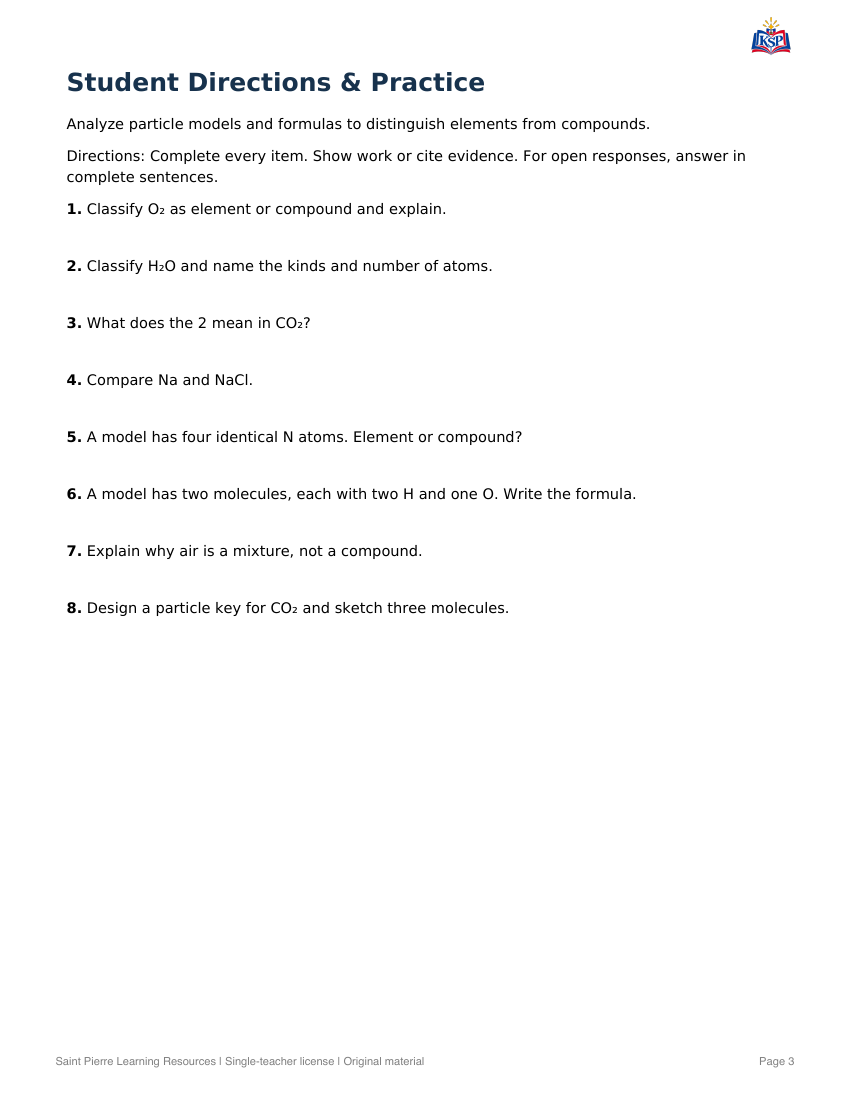
- Eight guided and independent practice tasks
- Assessment / exit ticket
- Answer key with worked guidance
- Accessibility and differentiation notes
- Table of contents with standards at a glance
- Name and date lines on student pages
- Terms of use, credits, and thank-you pages
Inside the PDF
- Page 1Cover
- Page 2Teacher guide, model, and learning supports
- Page 3Eight practice tasks
- Page 4Two skill-specific exit tasks and reflection
- Page 5Answer key and next teaching steps
Resource details
- Grade / course
- Grades 68
- Subject and resource type
- Science · Lesson and practice packet
- Files
- 8 main PDF pages · PDF
- Estimated completion time
- 40–50 minutes
- Answer key
- Includes a separate 3-page teacher-only answer key PDF with: full answer rubrics for every question, sample extended responses, vocabulary matching key, formative assessment tips, class data snapshot table (20 rows), and differentiation notes for ELL, EC, AIG, and 504 learners.
Standard or objective
NC Essential Standards: Phys.6-8.PS1.1 | NGSS: MS-PS1-1 Develop models to describe the atomic composition of simple molecules and extended structures.